Integrated Management and Sustainability Resources
Why AI Changes Sustainability Forever
Artificial intelligence (AI) is poised to reshape sustainability now and into the future by fundamentally changing how organizations collect information, make decisions, and coordinate action across complex social, environmental, and economic systems. We cannot forget or overlook the "human element" in the evolution of AI. Rather than serving as another standalone technology focused only on optimizing profits, AI provides us with the opportunity to function as an integrative capability that can synthesize vast quantities of operational, financial, supply chain, environmental, and stakeholder data into actionable insights that improve both strategic and day-to-day decision-making. This shift enables organizations to move beyond retrospective sustainability reporting toward predictive and prescriptive management, allowing leaders to anticipate climate risks, identify resource efficiencies, optimize energy and material flows, detect greenwashing, strengthen supply chain resilience, and evaluate trade-offs among financial, environmental, and social objectives in near real time. As AI becomes embedded within enterprise systems, buildings, digital twins, and organizational governance processes, sustainability will increasingly evolve from a compliance-oriented function to a dynamic management capability that is integrated across every business function. Organizations that combine learning, high-quality data, human expertise, transparent governance, and responsible AI practices will be better positioned to create long-term value, accelerate decarbonization, and build resilient organizations capable of adapting to an increasingly uncertain world.
“The illiterate of the 21st century will not be those who cannot read and write, but those who cannot learn, unlearn, and relearn,” - Alvin Toffler
I'm a paragraph. Click here to add your own text and edit me. It's easy.
BOOKS
Integrated Management
How Sustainability Creates Value for Any Business, 2nd Ed
Integrated Management is the process of including ESG performance in close coordination between business processes, groups, organizations, and systems. What can be done by individuals, functions, organizations, and entire value chains to integrate and align sustainability? It’s easy to say sustainability is important, yet not so easy to understand how it is part of the decisions that are made every day and how it cuts across business functions, systems, and supply chains. This award-winning book finds enterprises already on the path toward integrated management and strategic sustainable development. It considers the opportunity we have to enable an enterprise value proposition that includes ESG performance as a Return on Integration (ROInt). Winner of the Responsible Research in Business & Management (RRBM) Award.


The Power of Existing Buildings
Save Money, Improve Health, and Reduce Environmental Impacts
Your building has the potential to change the world. In The Power of Existing Buildings, sustainability expert Robert Sroufe, and construction and building experts Craig Stevenson and Beth Eckenrode, explain how to realize the potential of existing buildings and make them perform like new. This step-by-step guide will help readers to: understand where to start a project; develop financial models and realize costs savings; assemble an expert team; and align goals with numerous sustainability programs. Winner of the Academy of Management's ONE Division Book Award.



Strategic Sustainable Supply Chain Management (S3CM)
Book 1: Foundations
This book provides a multi-perspective approach to sustainability and value chains to allow understanding from a variety of disciplines and professional backgrounds. Some of the key features of this book include: Short vignettes of important trends along with relevant management issues; Evidence-based management examples from leading multinational companies, small, and medium enterprises spanning supply chains; References to appropriate tools, emerging technology, and practices; Chapter action items for the reader to take a deeper look at integration opportunities involving sustainability and supply chain management; An action-learning approach to applying concepts and tools so readers from any functional perspective can implement and manage sustainability projects including; Guidelines on how to move forward with your supply chain sustainability initiative. Winner of the Academy of Management - Organizations and Environment (ONE) book award.


Strategic Sustainable Supply Chain Management (S3CM)
Book 2: Implementation
Sustainability, ESG, and management practices are changing and changing rapidly. It is becoming more widespread as companies and customers uncover its power and attractiveness and sustainability also receiving more attention in the press. Support for sustainability lies within new tools, frameworks, and approaches. The authors capture these and other developments in this two-volume third edition of Strategic Sustainable Supply Chain Management.
The first volume, helps readers assess major management opportunities; the second volume focuses on implementation; when combined, the result is a complete, action-oriented treatment of sustainability. Written by two of the leading academic researchers in this area, this series introduces the reader, whether they are a student, manager, or experienced sustainability advocate, to the various tools, frameworks, best practices, and approaches to S3CM that work.


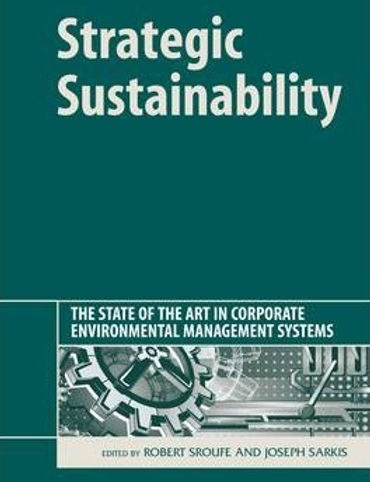
Strategic Sustainability
The State of the Art in Corporate Environmental Management Systems
It is now assumed that most companies have some version of an Environmental Management System (EMS) in place with systems ranging from informal policies and practices to formalized third-party certified systems. These systems are widely publicized by companies and are now integral to their strategic direction. No matter what level and type of system a decision maker chooses, both practitioners and researchers wish to examine and better understand the extent to which these systems are cross-functional, how they impact performance evaluation, their capability to monitor supply chains and the life-cycles of products and services and, most importantly, how these systems contribute to better environmental performance, reporting, and the sustainability of the firm.


Endorsements of Integrated Management and Testimonials
Paul Polman
Former CEO of Unilever
Integrated Management is making a simple but powerful case for developing your business model beyond shareholder primacy only and showing you practically and simply how to get started, integrate and reap the benefits. Comprehensive, actionable and enjoyable.
Stu Hart
Erb Institute, University of Michigan
Andrew Winston
Sustainability Strategist
The book makes an important argument and helps executives manage multiple capitals beyond just the financial - human, intellectual, manufactured, social, and natural - and this builds more sustainable and successful enterprises
Karl Henrik Robert
Founder, The Natural Step and MSLS Program
A must have for decision-makers seeking a customized approach to the integration of sustainability throughout an organization that is based on proven practices, i.e., the Framework for Strategic Sustainable Development.
John Elkington
Chairman & Chief Pollinator, Volans
Tomorrow's capitalism will value different things - and value them differently. In his timely, insightful book Integrated Management, Robert Sroufe explores what this means for business, integrated bottom lines performance, markets and, ultimately, all of us ...The sort of book I would have given my eyeteeth to possess half a century ago.
Andy Hoffman
Holcim Professor of Sustainable Enterprise
Within the pages you will find practical tools to help any business leader make balanced decisions, articulate an actionable vision and set his or her on a new long-term path towards addressing the great issues of our day. The book gives hope that we can come to terms with our sustainability challenges.
If business is ever to become a truly positive force in solving social and environmental problems, sustainability must be treated as a more than a proverbial "saddlebag" hanging off the side of the corporate horse. Integrated Management provides the vision, framework and tools to make sustainability core to corporate purpose.
Michael Mann
University of Pennsylvania
If you're looking for a comprehensive discussion of sustainable business practices, look no further... The book is an invaluable resource for decision makers looking to prioritize a sustainable planet as we strive to create business opportunities.
Mike Toffel
Harvard University
Glen Dowell
Cornell University
C
The most sustainable companies are those that have fully integrated sustainability into their strategy, products, operations, and marketing. Drawing on best practices, this highly accessible book describes why managers should drive such integration.
It's pretty clear that for businesses to really move the needle on sustainability, a more integrated approach is needed. The piecemeal, fragmented approach that has characterized most corporate sustainability efforts will simply not get us to where we need to go.
SELECT ARTICLES
Pennsylvanians Can Benefit from the Energy Innovation and Carbon Dividends Act
The revenue-neutral EICDA facilitates a market-driven implementation of clean energy technology to reduce pollution by placing a fee on the importers and producers of carbon-emitting fossil fuels, with heavy polluters paying higher fees
Transforming Business Education 21st Century Sustainable MBA Programs
A challenge offered to Universities, Business schools, and faculty to develop a curriculum that embeds sustainability in the core of their programs and courses.
Patent to Estimate Scope 3 GHG Emissions for Logistics
A patent for the process of estimating emissions both as a company and at the shipment level. This process enables shippers to receive Scope 3 emission reports for their own carbon tracking.
Effects of EMS on Environmental Management Practices and Operations
This study reports empirical insights to EMS practices based on the largest EMS survey of manufacturing firms in the United States. The objective is to find relationships between EMS and operations mangement
Torn Between Two Paradigms: A Struggle for the Soul of Business Schools
A focus on the emergent paradigm of an economy in service to life looks like and argues that Business schools will need to integrate both traditional academic disciplines and ESG performance while incorporating the major threats, and opportunities, facing businesses and society.
University Campuses: Living Laboratories for Transformational Programs
This chapter delves into why stakeholders were drawn to Chatham University’s Eden Hall Campus in Pittsburgh, PA. It explores the campus’s history, stakeholders involved in its design, and ongoing development efforts
Industry 4.0 and the Circular Economy
Exploring the Fourth Industrial Revolution (Industry 4.0) at the same time the circular economy has gained importance. We find parallels the growth in the internet of things (IoT), the circular economy poses both risks and opportunities to various stakeholders in its development.