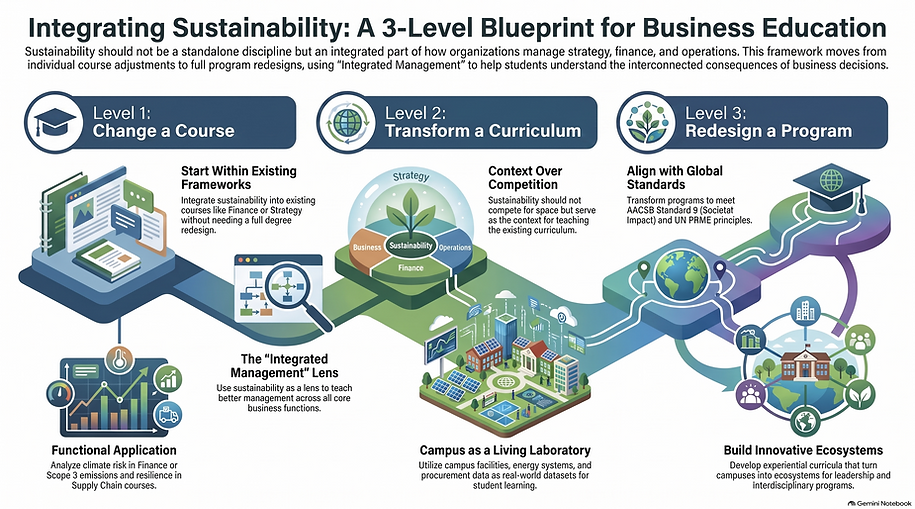
Transforming Business Education Through Sustainability & Integrated Management
Environmental and Social Sustainability should not be confined to a single course, concentration, or academic discipline. It is increasingly part of how organizations manage strategy, finance, operations, supply chains, innovation, technology, people, risk, and stakeholder relationships.
The opportunity for innovative Faculty and entire Universities is to move beyond simply adding sustainability content and instead ask a more important question: How can sustainability be integrated across the curriculum and into the capabilities we expect graduates to develop? We have the technology and capability to integrate environmental and social sustainability into every business function, but do we have the will and the leadership to back it up?
This curriculum resource hub, i.e., the books, research, application exercises, and curriculum-development work, provides faculty and academic leaders with evidence, frameworks, cases, and practical tools for integrating sustainability and systems thinking into individual courses, business programs, and interdisciplinary curricula. If, as Bill McDonough says, "design is the first signal of human intention," then what kind of programs, curriculum, and courses do we want to design and deliver to meet the needs of our time?
A design element and question for us to think about: How do we prepare future decision makers to manage organizations in a world where there is so much uncertainty around sustainability, AI, climate, stakeholder expectations, supply-chain risk, and financial performance are increasingly interconnected?
Change a Course
For faculty seeking cases, readings, frameworks, exercises, and assignments that integrate sustainability at the course level. Together, we can translate research into practice while integrating sustainability into every business function.
Integrated Management: A Foundation for Curriculum Transformation; Integrated Management: How Sustainability Creates Value for Any Business. How can students learn to manage sustainability as part of business rather than as a separate initiative?
Integrated Management provides faculty with a framework for connecting sustainability to the decisions managers make across strategy, finance, operations, supply chains, accounting, information systems, marketing, organizational behavior, innovation, and other business functions. Rather than treating sustainability as an additional topic to fit into an already crowded curriculum, integrated management asks faculty and students to examine the connections among functions, stakeholders, systems, performance measures, and decisions.
Use Integrated Management as a Resource To Teach:
Courses: Strategy | Operations | Supply Chain | Sustainability | CSR | ESG | Management | MBA Capstone
Concepts: Systems Thinking | Stakeholders | Materiality | LCA | Integrated Reporting | ESG Performance | ROInt | Strategic Sustainable Development
Student Skills: Systems Thinking | Critical Thinking | Data Analysis | Decision-Making | Stakeholder Analysis | Problem Solving | Integrated Management Strategy Development | Vision and Action Plans
The result is a different approach to management education: environmental and social sustainability becomes a lens through which students find management opportunities.
Start Anywhere to Integrate Sustainability Into a Course
You do not need to redesign an entire degree program to begin integrating sustainability.
Faculty can start within existing courses by asking students to examine how environmental and social issues affect the decisions already being studied. A finance course can examine capital allocation and climate risk. Operations can explore energy, waste, and resource productivity. Supply chain courses can investigate Scope 3 emissions, resilience, traceability, and supplier relationships. Strategy can consider stakeholders, systems, and long-term value creation. Accounting can examine integrated reporting and emerging performance measures, and changing international reporting standards.
Experiential Learning Course Examples & Resources
Functional Integration Application: in Chapter 5 in the Integrated Management book [link]
-
Integrate Across Business Functions — Examine how sustainability changes decision-making within accounting, finance, marketing, operations, technology, and organizational behavior.
-
Connect Strategy to Implementation — Identify the drivers for sustainability, the organizational enablers that make change possible, and the obstacles managers must overcome.
-
Measure Business and Sustainability Performance — Develop meaningful metrics that connect sustainability initiatives with strategy, ESG performance, value creation, and managerial decision-making.
Vision & Action Plans: in Chapters 1 - 15, explicitly in Chapter 15 of the Integrated Management book [link]
-
Develop a Managerial Point of View — Consider the changing role and responsibilities of business in addressing sustainable development.
-
Connect Learning to Career — Translate sustainability concepts into a personal vision for how they will influence future managerial decisions and professional practice.
-
Turn Vision into Action — Develop a practical action plan for using business and commerce to contribute to a more sustainable world.
Life Cycle Assessment Within MBA Courses: A Tool for Integrating Sustainability” Operations Management Education Review [link]
-
Integrate Sustainability into Existing Courses — LCA can be embedded into operations, supply chain, strategy, and other MBA courses without creating a new sustainability course.
-
Teach Systems Thinking Through Decisions — Students examine how choices about materials, products, processes, transportation, and supply chains create interconnected environmental and business consequences.
-
Move from Concepts to Experiential Learning — Project-based LCA gives students a practical decision-making tool for analyzing real products and services while developing problem-solving and cross-functional thinking
HealthCare’s Corporate Social Responsibility Program,” a Multi Criterion Decision Analysis Case Study, within Cases in Business Analytics for Supply Chain and Operations Management [link]
-
Evaluate Integrated Value — Compare sustainability investments using financial, environmental, social, operational, and organizational criteria.
-
Align Sustainability with Strategy — Connect project selection with corporate mission, stakeholder interests, operating costs, employee well-being, and community impacts.
-
Make and Defend Decisions — Apply business analytics to competing alternatives and develop an evidence-based recommendation for management
Aluminum vs Plastic: A Life Cycle Perspective on the Use of These Materials in Laptop Computers Case Study, within Cases in Business Analytics for Supply Chain and Operations Management [link]
-
Think Across the Life Cycle — Evaluate material choices from raw-material extraction and production through product use, durability, recycling, and end-of-life.
-
Connect Sustainability and Product Strategy — Examine how environmental performance interacts with cost, customer preferences, product design, pricing, and competitive positioning.
-
Build the Business Case — Translate life-cycle data into a value proposition that managers can use when making material and product decisions.
Use Experiential Learning To Teach:
Courses: any undergraduate or graduate course
Concepts: Systems Thinking | Stakeholders | Data Analytics | Integrated Reporting | ESG Performance | ROInt | Strategic Sustainable Development
Student Skills: Systems Thinking | Critical Thinking | Data Analysis | Decision-Making | Stakeholder Analysis | Problem Solving
Having successfully helped develop and deliver over 200 live projects with teams of graduate students, some of the resources below are based on this work.
Best Practices in Teaching Sustainability: Live Project Courses,” Decision Sciences Journal of Innovative Education [link]
-
Solve Real Business Problems — Engage students with external clients to address authentic sustainability and management challenges.
-
Integrate Across Business Functions — Apply finance, accounting, operations, strategy, analytics, ethics, and systems thinking within a single project.
-
Build Consulting Skills — Develop capabilities in research, data analysis, project management, teamwork, communication, and evidence-based recommendations.
Design for the Experience: A More Sustainable Future; Chapter 3 in Personal Sustainability Practices: Faculty Approaches to Walking the Sustainability Talk and Living the U.N. SDGs, Edward Elgar Publishing, edited by Starik, M, and Kanashiro, P. [link]
-
Design Memorable Learning Experiences — Move beyond lectures by using projects, buildings, products, data, and real sustainability challenges as learning environments.
-
Connect Personal and Managerial Decisions — Use familiar systems such as homes, buildings, energy, and transportation to make sustainability tangible and transferable to business decisions.
-
Turn Measurement into Action — Establish baselines, explore ambitious alternatives, and integrate financial, environmental, and social value into investment decisions.
Fishbanks MIT Simulation [link]
-
Experience Resource Constraints — See how business decisions interact with finite renewable resources and changing ecological conditions.
-
Navigate Competition and Cooperation — Balance individual economic objectives with negotiation, collective action, and long-term resource sustainability.
-
Learn Through Consequences — Make decisions, observe system responses, and experience how short-term incentives can create long-term managerial challenges.
ENRoads Climate Solutions Simulator [link]
-
Experience Systems Thinking in a Dynamic way — Explore how energy, technology, policy, business, and societal choices interact within a complex global system.
-
Test Decisions and Tradeoffs — Experiment with alternative strategies and immediately see their environmental, economic, and social consequences.
-
Build Managerial Decision-Making Skills — Move from learning about climate change to analyzing scenarios, evaluating alternatives, and making evidence-based decisions.
The objective is not simply to teach more sustainability. It is to help students become better managers by understanding the interconnected consequences of their decisions.
Transform Curriculum
The specific content, lessons, and materials taught within that program: For departments and schools seeking to integrate sustainability across disciplines rather than isolate it within individual courses.
Rethink Business & Management Education
Torn Between Two Paradigms: A Struggle for the Sole of Business Schools [link]
-
Rethink the Purpose of Business Education — Examine the assumptions about business, markets, growth, and value creation embedded within traditional management curricula.
-
Integrate Sustainability into the Core — Move sustainability and social responsibility from the periphery into strategy, finance, operations, leadership, and other established business disciplines.
-
Prepare Managers for Systemic Challenges — Develop curricula that help students understand interconnected economic, environmental, and social challenges rather than managing them as separate issues.
Transforming Business Education: 21st Century Sustainability Programs [link]
-
Challenge Traditional Assumptions — Examine how conventional assumptions about markets, growth, profit, and value creation shape management education.
-
Integrate Across the Curriculum — Embed sustainability and societal challenges within traditional business disciplines rather than adding them as stand-alone electives.
-
Prepare Leaders for Complex Systems — Use systems thinking, experiential learning, and interdisciplinary approaches to prepare managers for interconnected business, social, and environmental challenges
Aligning the PRME: How International Study Nurtures Responsible Leadership,” Journal of Management Education [link]
-
Integrate Global Experiential Learning — Use international fieldwork to connect social, environmental, and financial responsibility across business disciplines.
-
Develop Responsible Leaders — Build students' capabilities as stewards, global citizens, change agents, and meaning makers through immersive experiences.
-
Connect Curriculum with PRME — Intentionally align learning outcomes, partnerships, reflection, and experiential pedagogy with the Principles for Responsible Management Education.
Integrated Management Across Business Functions
Chapter 5 of the book explicitly addresses Integration Across Business Functions and frames sustainability as something that can become part of enterprise functions rather than remain siloed.
*Sustainability doesn't need to compete for space in the curriculum. It can become context for teaching the existing curriculum.
Campus as Living Laboratories
Facilities, buildings, energy systems, food systems, transportation, procurement, water, waste, biodiversity, digital twins, and campus operations can become datasets and learning environments.
Business Schools as Living Labs: Advancing Sustainability in Management Education [link]
-
Turn Buildings into Learning Laboratories — Use campus buildings and operations as real-world environments for experiential management education.
-
Integrate Sustainability into Investment Decisions — Have students evaluate building improvements using financial, environmental, carbon, health, and productivity outcomes.
-
Measure Integrated Value — Move beyond conventional ROI by applying Social Cost of Carbon, Return on Integration (ROInt), Integrated Rate of Return, and Integrated Future Value.
University Campuses: Living Laboratories for Transformational Programs,” Breakthroughs in Sustainable Business Education: Change-makers in Action, Edited by Irwin, L., Fritz, M., and Rimanoczy, I. as part of the Global Movement Initiative, book chapter, Published December 30, 2024. Routledge. ISBN 9781032832388 website
-
Turn Campuses into Living Laboratories — Use buildings, energy, water, food, landscapes, and campus operations as real-world environments for teaching sustainability.
-
Connect Curriculum and Operations — Bring students, faculty, facilities professionals, and external stakeholders together around authentic organizational challenges.
-
Create Experiential Learning — Give students opportunities to analyze real systems, work with real data, and develop solutions with visible consequences.
Sustainable Operations & Supply Chains
How can sustainability become part of operations, supply chain, and analytics education? Environmental management, EMS, carbon emissions, Scope 3 GHG emissions, and operations research contribute to this.
Systems Thinking, Measurement & Decision Making
This can bring together LCA, integrated reporting, ROI/ROInt, materiality, MCDA, ESG measurement, systems thinking, and related work in this functional domain. Integration is particularly valuable here as we progresses from understanding complexity through assessment and prioritization to measurement, alignment, and strategy.
Use of the Social Cost of Carbon Dioxide (SCC) [link]
-
Make Externalities Visible — Translate the climate impacts of carbon emissions into economic terms that can inform managerial decisions.
-
Integrate Carbon into Business Analysis — Bring climate impacts into cost-benefit analysis, investment decisions, strategy, operations, and risk assessment.
-
Evaluate Long-Term Tradeoffs — Explore how uncertainty, discount rates, and future climate damages influence present-day decisions.
Sroufe, R., Jernegan, L. (2019). “Making the Intangible Tangible – Integrated Management & the Social Cost of Carbon,” Book Chapter, Business and Society 360, Volume 4: Sustainability, Edited by Wasieleski, D. and Weber, J. Emerald. [link]
-
Make the Intangible Tangible — Translate environmental and social impacts into metrics that managers can incorporate into business analysis.
-
Expand Financial Decision-Making — Use ESG performance measures and the Social Cost of Carbon to broaden conventional approaches to evaluating investments and value creation.
-
Integrate Across Business Functions — Show how sustainability information can inform decisions across finance, strategy, operations, supply chains, and other management functions.
The Un-balanced Sheet: A Call for Integrated Reporting”, New Perspectives on Corporate Social Responsibility, Editors: Linda O’Riordan, Piotr Zmuda, and Stephan Heineman; Springer Fachmedien Wiesbaden, Germany. [link]
-
Expand What Business Measures — Look beyond traditional financial statements to include environmental, social, governance, and other forms of organizational capital.
-
Connect Reporting with Strategy — Use integrated information to understand risk, identify opportunities, allocate resources, engage stakeholders, and improve strategic decisions.
-
Redefine Business Value — Examine how financial and nonfinancial performance together provide a more complete picture of long-term organizational value.
*what the National Society of Accountants say about Intangibles, make them count! [link]
Georgeson, A., Johnson, T., Mulholland, B., and Palumbo, D., under the supervision of Sroufe, R. “Impact of the Energy Innovation Carbon Dividend Act on the State of Pennsylvania,” with project partner, the Citizens Climate Lobby – Pittsburgh. 2020. Available here [link]
-
Analyze Real-World Policy Impacts — Use data analytics to examine how carbon policy can affect households, employment, energy, and regional economies.
-
Connect Climate and Economic Decisions — Explore the relationships among carbon pricing, household costs, jobs, energy transitions, and investment.
-
Turn Coursework into Client-Based Pedagogy — Apply classroom knowledge to a real sustainability challenge for an external organization and policy audience.
Redesign a Program
The course of study for a degree or a certificate: For academic leaders developing or transforming undergraduate, MBA, sustainability, leadership, and interdisciplinary programs. Helping to build internationally recognized MBA programs, turning campuses into innovative ecosystems, and developing experiential curricula.
The Management for Global Sustainability Opportunity: Integrating Responsibility, Sustainability, and Spirituality; Journal of Management for Global Sustainability [link]
-
Expand the Purpose of Management — Explore business responsibility beyond financial performance to include people, society, nature, and human flourishing.
-
Connect Values and Sustainability — Examine how responsibility, sustainability, and spirituality can inform managerial thinking and decision-making.
-
Develop Reflective Leaders — Encourage students to consider their values, relationships, and responsibilities when confronting complex sustainability challenges.
Institutional Transformation
Connect curriculum with campus operations, research, community partnerships, overall education, and organizational strategy.
Universities worldwide are redesigning management education. Learn more about why and how this is happening...
-
UN PRME -- a United Nations-supported initiative transforming business and management education for a more sustainable future.
-
AACSB Standard 9 (Societal Impact of Business Schools) -- the accreditation requirement focused on Engagement and Societal Impact for business schools
-
Positive Impact -- a global, student-led assessment that evaluates business schools on their commitment to sustainability, ethics, and societal impact.
-
UN Sustainable Development Goals (SDGs) -- a collection of 17 global targets set by the United Nations in 2015 to achieve a better and more sustainable future for all by 2030.
Responsible management education • UN Sustainable Development Goals • Sustainability competencies • Experiential learning • Systems thinking • Interdisciplinary education • AI-enabled management education • Assurance of learning
*This site will be continuously updated. Check back, and send us resources related to this page.
Contact us for a copy of our annually updated compendium of curriculum resources....